EXPOSED: 2 OVERLOOKED levers consumer brands can’t ignore before scaling from $3M to $100M (& how to implement it)
BONUS: low-hanging fruits to implement this for a smoother scale for consumer brands of all categories, shapes, sizes and likings.

Is your ecommerce brand doing between $1M-$10M in sales? in for a treat?
Let’s start this off with a personal story…
(lets challenge you to see if you can pick up the 2 big levers & where this is going, early)

There was a big event coming up & I had to buy luxury carpets to host a dinner at my place.
My budget for this was about $65 (being all luxury), so I went to a dealership to buy these carpets.
As we entered the place, they had set the scene right:
It was the smell of an Oud luxury incense stick, dim top-down yellow lighting, glass walls till the roof, minimal design.
A well-groomed, charismatic representative walked in, shook our hands, and dressed in clean formals.
As I am looking at the rugs, this one handcrafted rug catches my eye.
It was about $90 ($25 over my initial budget, but maybe not today)
I ask him the best price on this:
He says,
"Oh, this is $90, but for you, let's make it $85."
And I see a sticker on the rug that says three things:
- "Lifetime Craftsmanship Warranty": Complimentary repairs if fringes, edges or knots come loose, subject to warranty terms.
- "30-Day Money-Back Guarantee": Full refund if you decide it's not the right fit, subject to the return policy.
- "Try It at Home": Take it home and experience it in your space for a week before making your final decision, with a full refund if you return it within the trial period.
Immediately I thought to myself:
"Wow, these guys know what they are doing. They've made the purchase much easier by addressing my three biggest concerns in three sentences, and the salesman didn't even have to explain a thing?"
Right as I was thinking & reading that, the salesman hands me something.
"Here is a brush to clean it without a vacuum. This comes free with the rug. I have something else for you, let me be back..."
And he goes to get another thing while I admire this brush that matches the rug's design.
He gets me four other things and hands them to me:
- Rug pad / non-slip underlay: This helps reduce slipping, protects the floor, and helps extend the rug's lifespan. (this was a concern in the past for me as my floors are marble)
- Stain removal kit: A gentle wool-safe cleaner, a cloth, and a spray designed to help remove insects and bugs.
- Storage or carry bag: A breathable cotton bag for when you roll it up or move house.
And finally,
- Rug Care eBook (he would send this to my email): A step-by-step monthly cleaning guide so you or your cleaners can maintain your rug and keep it looking its best for years. (this is great to give to my cleaners)
And as he explains all of these things individually, he says:
"Most of these things individually would cost you about $25, but you get them as complimentary bonuses with the rug if you purchase within the promotional period of a day’s time."
“And what happens if I do not buy today?” I ask.
“You can still get the rug for the same price but you do not get the bonuses for free… ” he answers.
I went in here wanting to buy a basic luxury rug for $65 & now I am considering an $85 rug, as the offer that was presented was too good to pass up on...
I say,
"Okay, let's do it."
As he smiles, picks up the rug & the bonuses and walks towards the counter, he stops.
Right before I check out, he asks me one last question.
"If I may ask you, how many rooms, bathrooms & kitchens do you have?"
"Ummm... 1 kitchen, 2 bathrooms & 4 rooms..."
He says,
"Would you like to buy carpets to match the rug so your house looks on theme? We have about 7 carpets that would complement your rug, and the stain removal kit works for everything. It's just an additional $45, but since you're buying the rug, it's $35 as a one-time offer."
Now I have entered a hyper-buying cycle because I do want my house to look on theme & it does make sense with the purchase, plus such a great discount? I was sold.
Now we are at $85 (rug) + $35 (carpets)
I thought to myself…
“damn these guys got me good”
I went in with a budget of $65. I walked out CONSIDERING “$120”
almost double…
“I say sure let’s do it”
Final question he asks before we actually go to check-out:
"How big is your living room? This rug is a 2.5 x 8 ft. We can upgrade it to a slightly bigger 3 x 10 ft at 10% off."
Now, as I almost considered it, I remembered that my sofas were gigantic & I had just bought a rocking chair,
so I politely declined.
But close try, almost did it too…
I got my card out and paid the $120 and thought to myself, wow, I really thought $65 was the ceiling for today?
I was a happy customer afterwards because it lived up to my expectations.
They gave me value beyond the purchase & did it in a smooth, subtle way.
I referred them to a lot more people and bought from this store for my other house too…
The company here pulled 2 levers really well. (Could you guess which ones?)
I know what you are thinking, does this apply to online commerce?
We've applied these principles across 35+ companies, with promising results.
The funny thing is that even while I knew the manoeuvres this company was pulling, I still considered almost every offer because these are timeless principles that can work regardless of the products you sell, where you sell, etc.
If you sell online, these principles are worth understanding.
Regardless of what you sell.
These are some of the lowest-hanging fruits that can have a significant impact on top-line sales without additional ad spend, no change in creative team, no increase in traffic volume or even without a MEGA COOL influencer with millions of followers.
The only condition is that your company should ideally be doing over $100k/mo in D2C sales, as these strategies are generally more impactful when you already have an established product, consistent traffic and a validated product-market fit.
But these could potentially be optimisations and systems that improve sales, which could be implemented within a few weeks and sometimes with just a text message to a designer, while creating opportunities to improve top-line revenue and margins so that the leaders can work on product, create a brand and build a world-class team.
In fact, this first lever is so overlooked, even by billion-dollar companies, but can influence purchasing decisions and is often the tip of the spear of a landing page.
How do we know? Because my team has worked with these levers on massive enterprise level brands to work on these exact systems.
And A BIG FAT NO, none of the suggestions in this page has anything to do with:
- Signing a star agency for a gazillion dollars a year.
- Increasing ad spend to 10x to get 100x the return (ridiculous).
- Signing an influencer/celebrity that will make the brand a household name overnight.
In fact, when considering these above steps, these two levers can help amplify the impact of everything above.
So getting this right is crucial.
If D2C is a major driver of sales for your brand and you overlook these fundamentals:
Traffic acquisition can become increasingly expensive, and customer acquisition costs can put additional pressure on your margins.
Compressing your margins and putting pressure on your business economics.
You need to nail this tip of the spear before you work on anything else.
Now that we know this is important, let's get into the nitty-gritty.
Drop your name and email below to unlock the rest, plus we'll send you some genuinely useful materials and tools to put this into practice.
We didn't hold anything back on how we increase order values & conversion rates for our dozen brands, with examples, cases & implementation plans.
No spam. No BS. Just the good stuff.
This is based on a concept we call: website revenue capture maximisation.
Which means that, keeping everything you are doing the same,
We want more cold traffic that ends up on your product pages,
TO BUY AND AT MORE VALUE…
Meaning more cold visitors buying, and buying at a higher average order value.
This is a combination of improving conversion rates & average order values.
Hypothetically speaking,
If the monthly sales of a D2C toothbrush brand on cold traffic is $300k/mo
& hypothetically, converting at 2% on average, with an average order value of $20,
So they are making 15k sales to hit $300k/mo,
Keeping all else the same,
If we take the conversion rates from 2% to 3%, they'd be making $450k/mo.
And at a 4% conversion rate, they'd be making $600k/mo.
They didn't put any more into ads and neither did they change anything about their teams,
Nor did they build a super-genius AI agent to do this.
This is pure math and timeless systems.
Let's take this a step further now.
Now keeping the 4% conversion rate and at $600k/mo, if we increase the average order value from $20 to $35, we would be at $1,050,000/mo without changing anything else.
This is just optimising the mathematics on your website.
This system can be implemented over a structured six-week process and can be one of the first levers to pull,
Before you consider an agency, more investment into ads, a big campaign or a new product launch.
In fact, personally, we don't even work on or touch anything before this is properly evaluated for our consumer brand clients.
We want the most number of visitors possible buying from the website and at the highest sustainable value possible.
We want to be aggressive with this part while aiming for ambitious numbers like 6%, 7%, 8% conversion rates and higher AOVs, where the product, market and traffic quality support those targets.
This is because any effort related to traffic and products can become a force amplifier after.
Now going back to the toothbrush company example,
Instead of working on the lowest-hanging fruit to get more results out of existing traffic,
Most brands sign an agency for $4,000 a month and spend more on ads,
Potentially putting further pressure on their website economics.
It's like trying to learn and figure out how to put rockets in space,
Without working on your knowledge about physics first.
That being said:
This whole system is not rocket science.
(No pun intended.)
The whole system is just a sequence of steps that can be implemented methodically.
The challenge, however, is to be methodical with your testing.
It is testing one variable at a time to identify opportunities for improvement.
So far we have covered the "Why" this is important.
Now let's cover the "How" to put this into action.
Website Revenue Maximisation has two parts to the system:
- Maximising Conversion Rates (getting more visitors to buy).
- Maximising Average Order Value (getting each customer to buy for more value).
Let's break these down sequentially and use a real-life example for a brand of ours (we have amended the names and kept the numbers realistic in order to preserve the brand's privacy, while keeping the underlying example representative).
LEVER I: Maximising Conversion Rates (Getting more visitors to buy)
This is important, as we want more of the cold visitors on our website to buy and purchase at a higher value.
Let me introduce you to "Clear", a skincare brand.
This brand was doing $150,000 in revenue every single month, based out of Bangalore, India.
The traffic was cold and came from Meta ads and Google PPC.
The founder came to us asking us to scale their ads, but when we opened up the data,
The steps ahead were way different.
The conversion rate on cold traffic was about 1.7%.
Ad spend on Meta was about $75k, generating approximately $150k in revenue.
Giving them a 2x ROAS.
The founder's instinct was to scale ads and improve ROAS…
However, we identified an opportunity to focus on the lowest-hanging fruit: improving the 1.7% conversion rate towards a 3–4% target. (potentially even more)
Based on the same traffic volume and proportional revenue assumptions, this would translate into:
At a 3% conversion rate: approximately $265K/month (equivalent to 3.53x ROAS).
At a 4% conversion rate: approximately $353K/month (equivalent to 4.71x ROAS).
These were illustrative projections based on the existing traffic and spend, rather than guaranteed outcomes.
This was a more controlled opportunity to investigate compared to:
- More ad spend (as additional spend doesn't necessarily translate into proportionate returns).
- Replacing the team/agency to scale ads (as results and execution capabilities can vary).
- More & better creatives (as additional investment would be required for production).
- New channels (as there might be a learning curve before generating consistent results).
To implement the initial changes, it took about 6 weeks, with improvements in conversion performance.
& to methodically test this took about 12 more weeks, allowing us to evaluate additional opportunities and make incremental improvements.
This is why we decided that it was best to work on this before anything else.
It presented an opportunity to improve website economics, work with existing traffic and potentially generate better returns compared to some of the alternatives.
This is how the landing page of a sunscreen lotion converting between 1.7%–2% looks like.
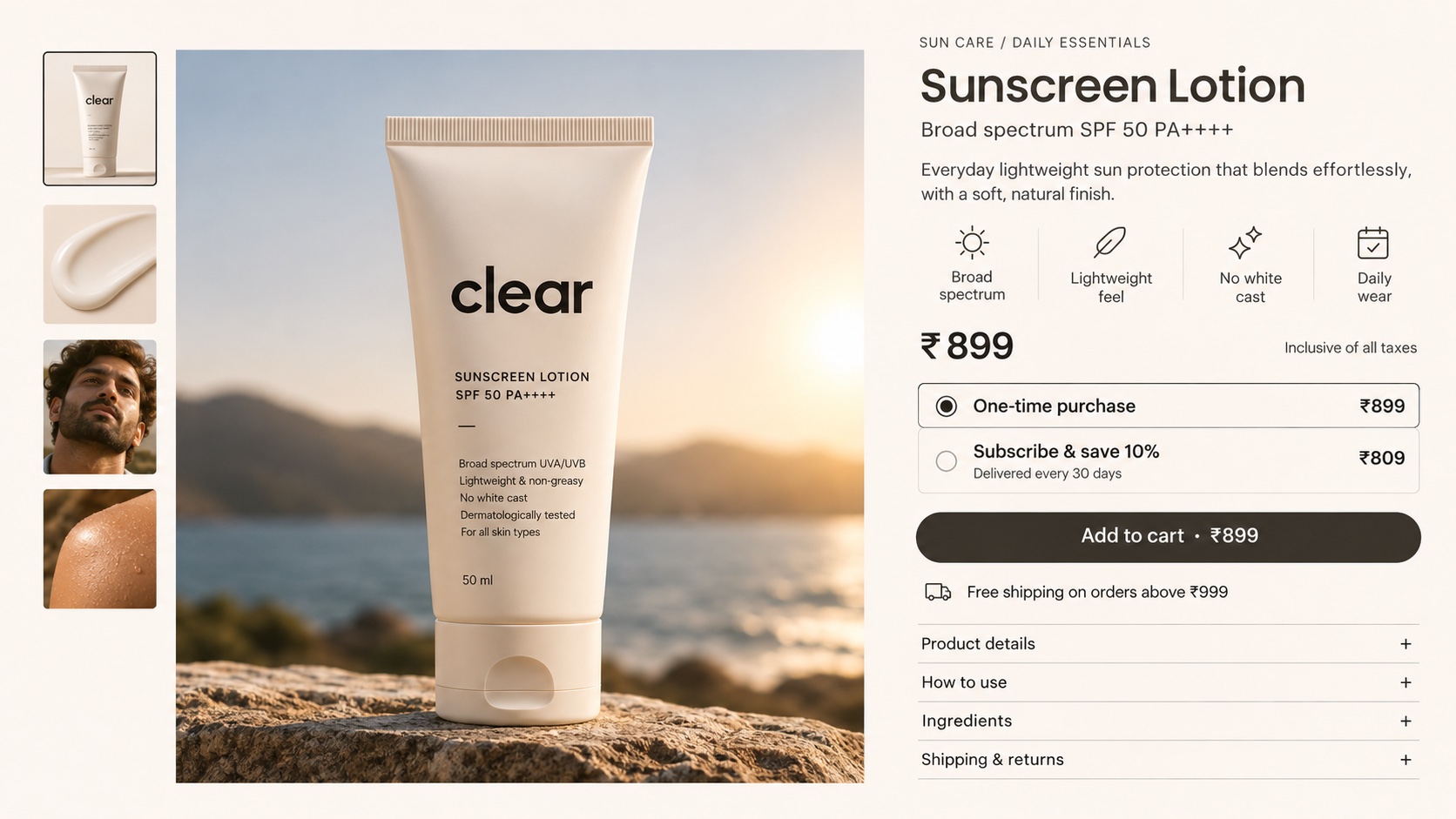
It covers the bare minimum basics like features & benefits, FAQ, product name, mock ups & a potential upsell into the subscription offer.
There are subtle features displayed and a clean product mock up.
Now we want this to double or triple in conversions so there are three steps to this:
Step 1: enhance the offer & make it irresistible (75% of the heavy-lifting)
Step 2: make the landing page compelling and sell the offer not the product
Step 3: make the buying logistics easier
Let’s begin with
Step 1 of Lever I (high CR%): Crafting an irresistible offer
OFFER ENHANCER #1: BONUSES
This is a relatively basic offer, as most of the perceived value is currently communicated through price.
We aren't reducing purchase hesitation through additional value, making the offer more compelling through bonuses or introducing genuine scarcity & urgency.
Right now, what is driving most of the sales is the pricing being at the forefront and the influencers promoting the product.
The first thing to do is to add bonuses to the offer.
A few things about the bonuses are that:
- They should be a natural next step to the product or be relevant to product usage.
- Bonuses that address common customer objections can work better.
- Using information as an added-value resource is one of the easiest ways to get started.
Bonuses are relatively easy to add and can enhance the perceived value of the offer and the overall presentation of the page.
You are only limited by creativity, but you must be aware of the sequence of testing, as introducing too many variables to your landing page simultaneously will make it difficult to identify what is actually driving performance.
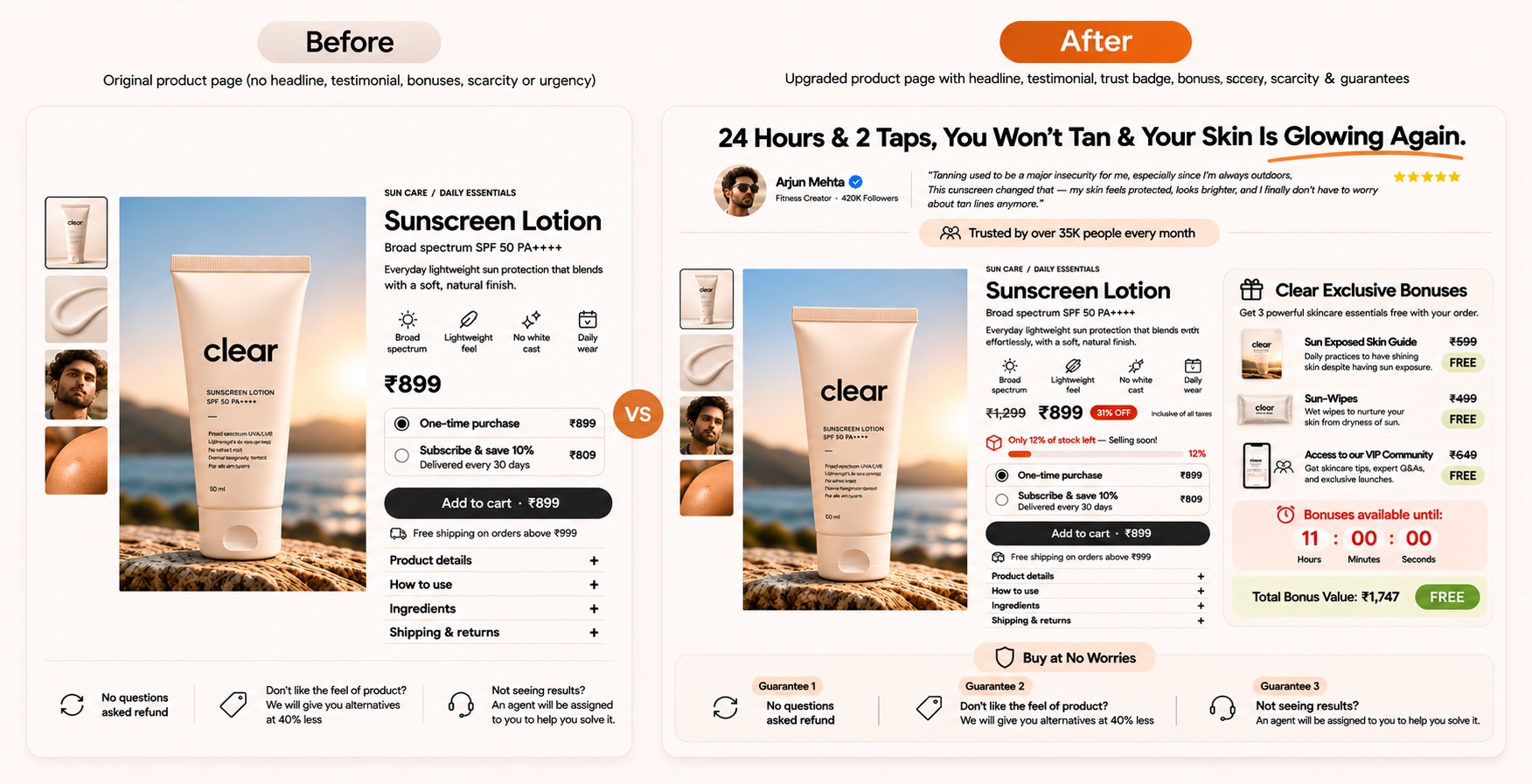
Here is what the page looks like with the bonuses
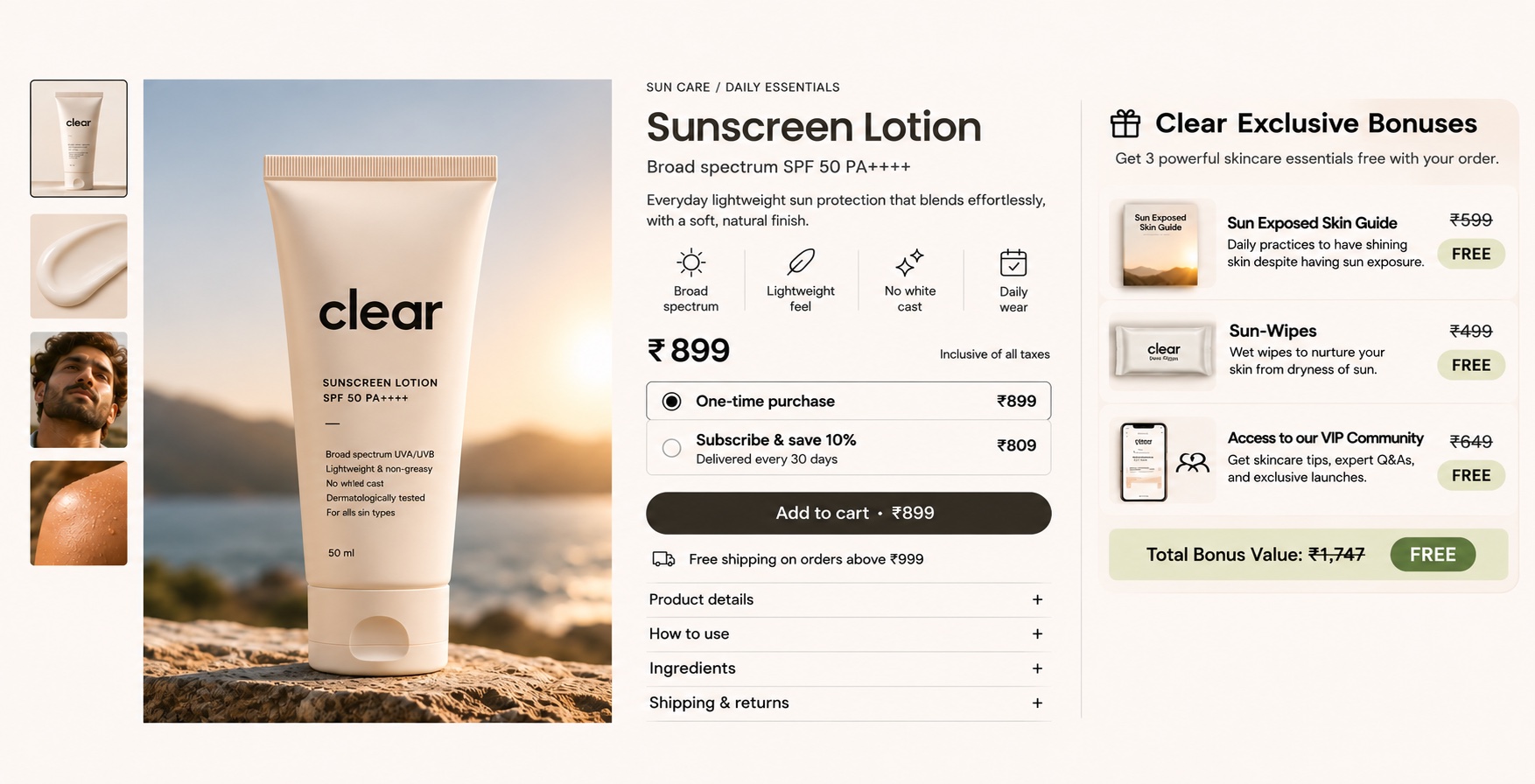
This is what it looks like before and what it looks like now.
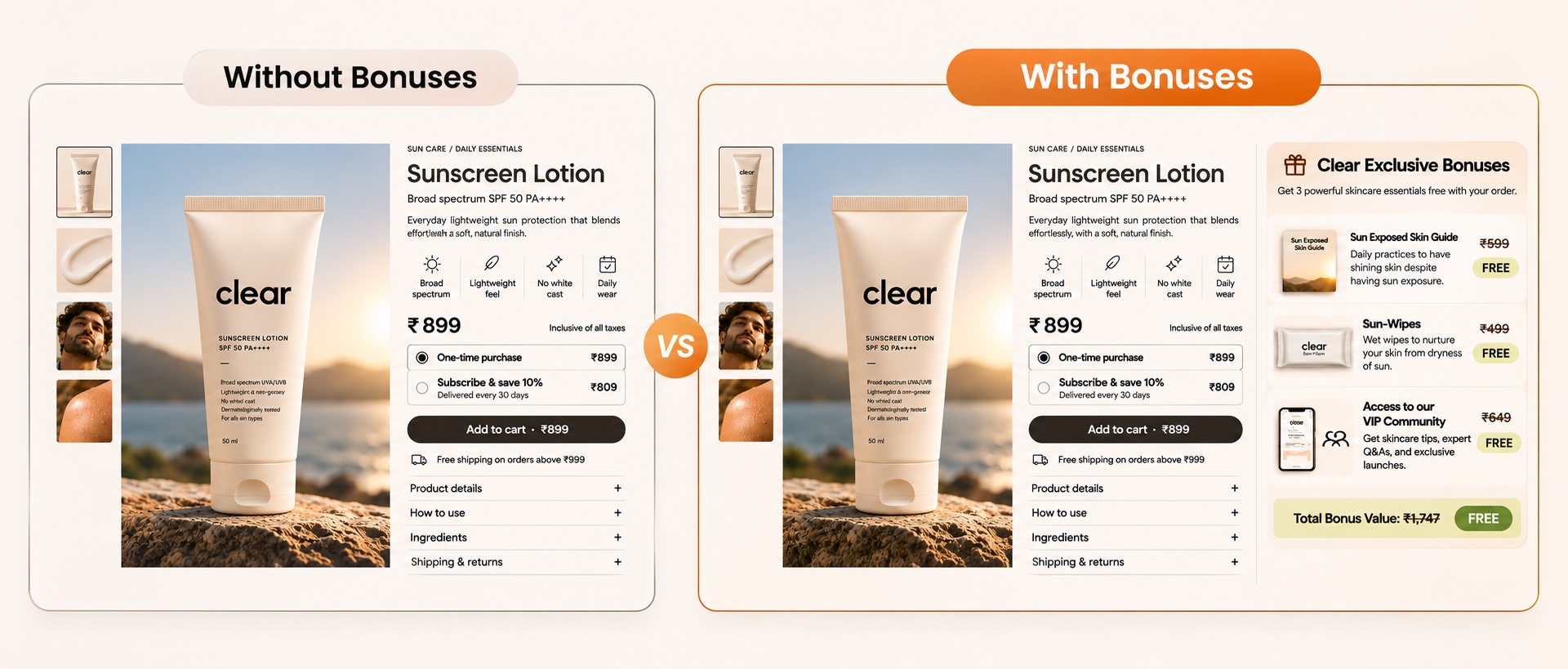
A point to note is how the page before was converting at 2% and now you can see that we have added 3 specific bonuses:
- Sun-exposed Skin Guide
- Sun-wipes
- Access to VIP community
Now these 3 bonuses are a natural next step to the product and there are no rules as such for the products as bonuses: We added an e-book, sun-wipes product as a gift & access to our VIP Community.
Although these might cost a little bit on your end; if it is going to play a massive role in the conversion rates, it will dramatically impact sales so it is worth investing in.
I added the bonuses in an entirely different section but many founders don't want so much attention on it; they just want it to be a reinforcing decision.
Hence another option is to be subtle but efficient with the bonuses.
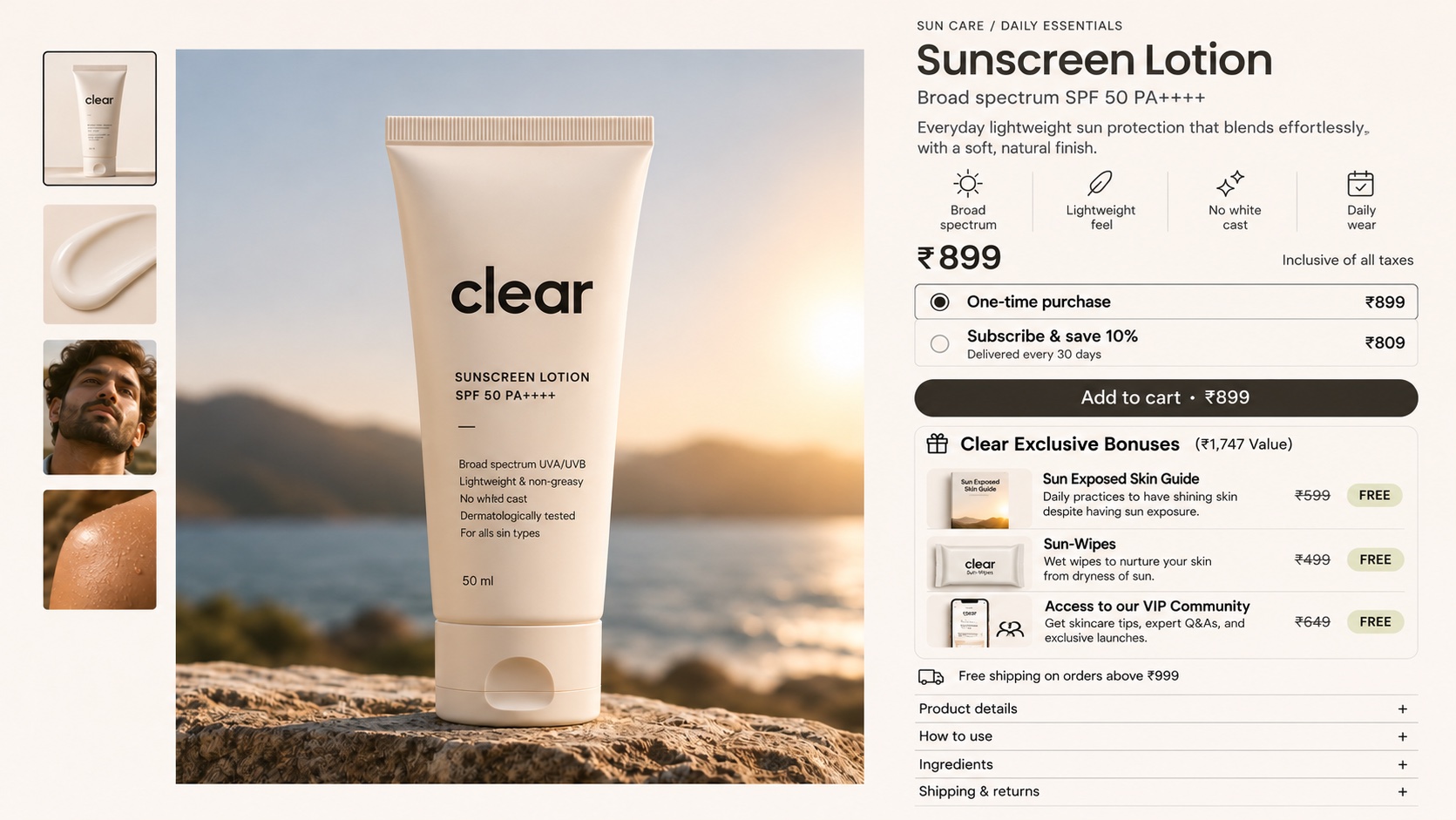
Ideally the offer is going to be the first scroll, we want to ensure that this first scroll is optimised for offer; if the scroll below this, and THEN we show the offer: the % of people reading it will dramatically reduce.
OFFER ENHANCER #2: SCARCITY & URGENCY
Now, taking the offer and turning it up a notch is a simple but effective step.
This lever impacts how soon customers make a purchase and helps move them beyond simply adding a product to their cart.
This is scarcity & urgency.
Scarcity is a unit of quantity and urgency is a unit of time.
Both of which are important in driving sales, as they encourage buyers to make purchasing decisions in different ways.
Scarcity can be implemented in a multitude of ways:
Scarcity of stock,
Scarcity of bonuses,
Scarcity of free shipping,
Highlighting genuine sales milestones, such as products selling out multiple times this month…
Urgency can be implemented in multiple ways too:
Only X time until the promotional price expires,
Only X time until the free shipping offer expires,
Only X time to claim the complimentary bonuses,
Only X time until the promotional window
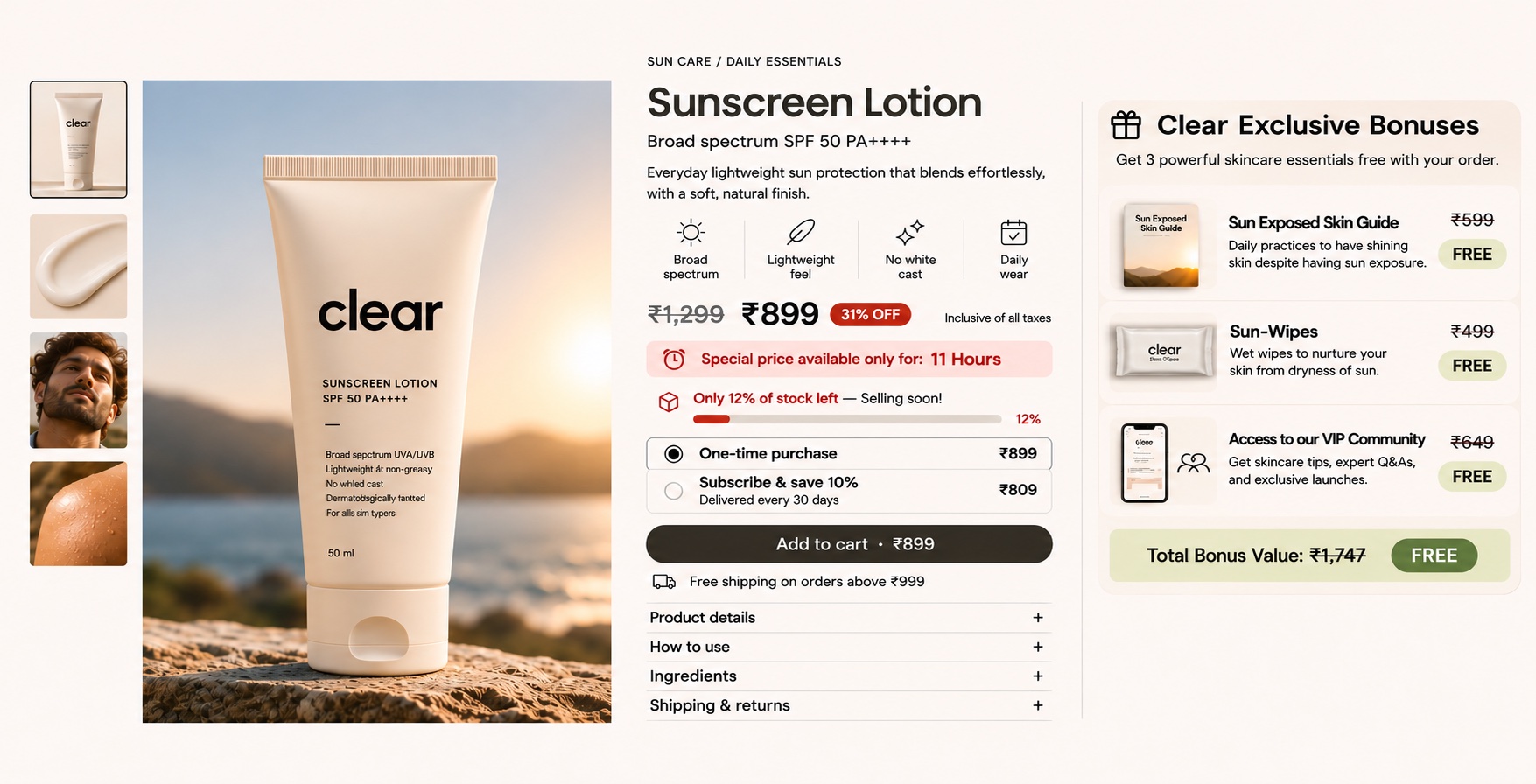
In this specific case we added a basic special price urgency and a basic stock scarcity. Let's now see another instance of urgency on the bonuses rather than the product.
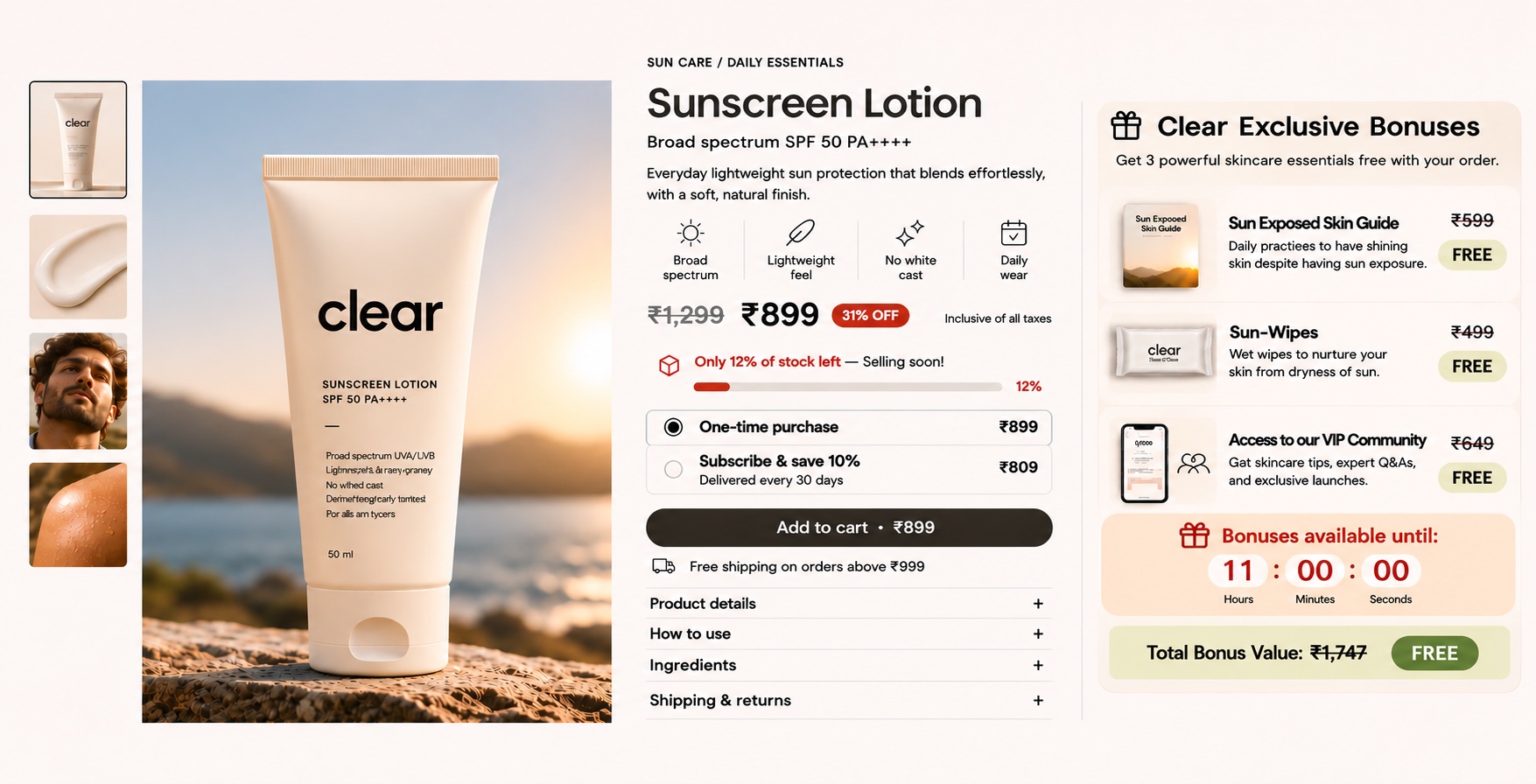
There are about 70+ ways to use scarcity and urgency but all of them do one thing. Get the visitors to buy as soon as possible.
Now we need to be ethical with this as scarcity and urgency being false for the sake of sales will damage our brand reputation which is worse than any % lift in conversion rate.
We need to be serious about our bonuses and realistic about the bonuses ALWAYS. This is a non-negotiable.
OFFER ENHANCER #3: GUARANTEES
Now let's turn this up a notch & this is by far one of the biggest levers for the product.
Guarantees help reverse perceived risk for an individual buyer. They are crucial.
Guarantees have to be well thought out and should be based on customer objections.
It is worth considering how these guarantees can address as many purchase concerns as possible and reduce the perceived risk on the consumer's end.
Now, would a small percentage of people ask for refunds? Sure.
But a well-structured guarantee can help build trust, reduce purchase hesitation and make more buyers comfortable with purchasing every month.
Being confident with your guarantees is recommended because they should ideally make your product an easier choice.
If you're hesitant to add them, I have one question for you:
Where is it that you are not confident about your product?
If you truly believe in your product, this should be an easy addition to your page and could create an opportunity to improve conversion rates.
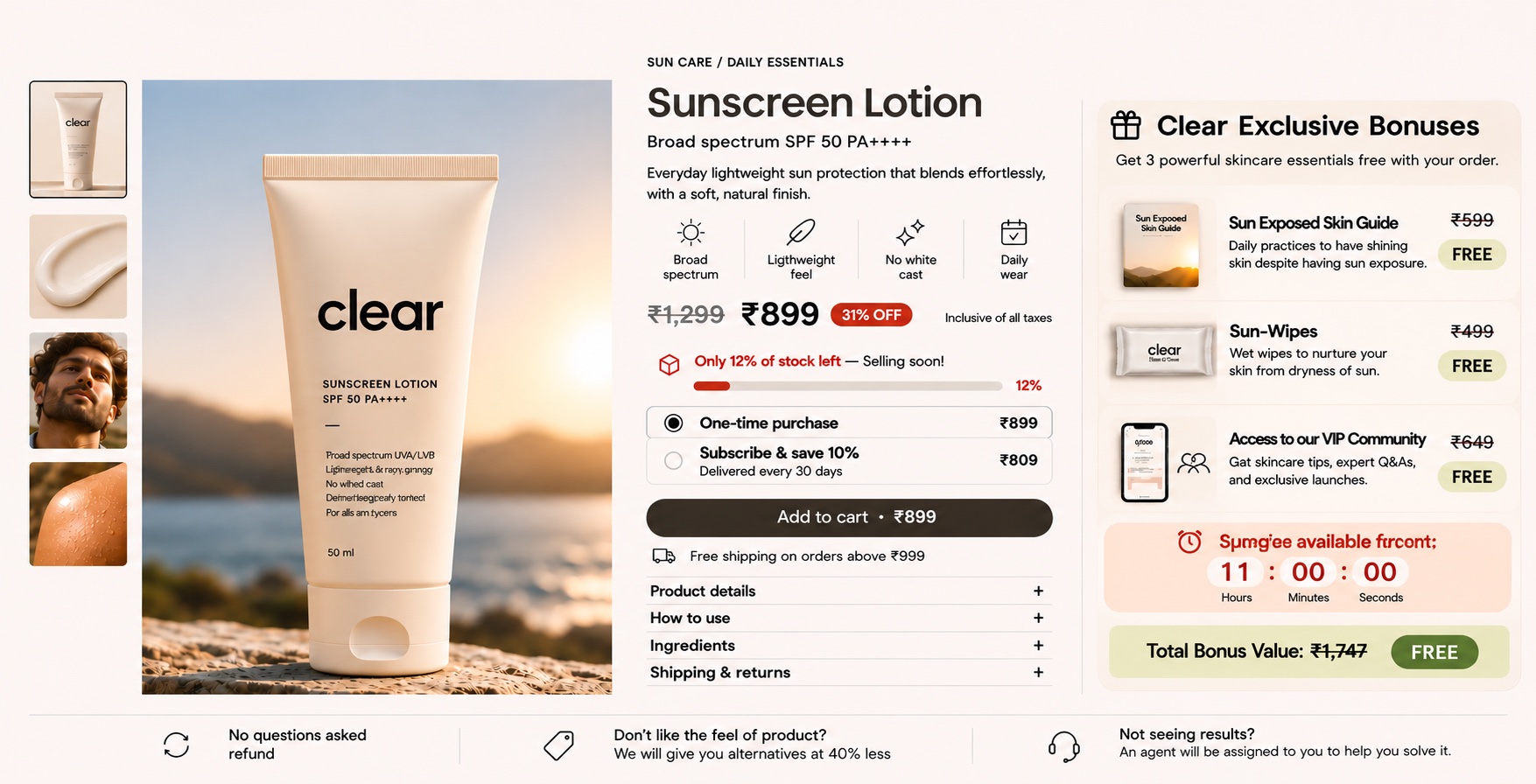
Here we added 3 guarantees, which are:
- No Questions Asked Refund: In case they decide the product isn't right for them, they can request a refund under the stated refund policy.
- Product Feel Guarantee: And in case they don't like the feel of the product, we'll help them explore alternative options at up to 40% less, subject to availability and offer terms.
- Customer Support Guarantee: And if they need additional guidance on using the product, we'll assign an agent to help them navigate the process.
These 3 guarantees are designed to address some of the biggest purchase concerns and reduce perceived risk on their end.
We could also go above and beyond with this by adding a "Damaged Pack Guarantee", where customers could receive a 150% refund if their package arrives damaged, subject to clearly stated eligibility and claim conditions.
We could be really aggressive or really soft here.
But the point is that stronger, well-structured guarantees can make the offer considerably more compelling.

Ideally, we do not need too many guarantees (though it is tempting), because we don't want to clutter the page with too many variables.
The placement of the guarantees can be tested as well.
When my clients are selling products like "collagen peptides", we want to address purchase concerns early.
So the guarantees are bold and upfront…
This totally depends on the target CR% and the product that you are selling.
But being intentional about every part of the offer is crucial.
This now completes our offer and how we stacked the different levers together.
- Guarantees that reduce perceived purchase risk.
- Bonuses that enhance perceived value.
- Scarcity & urgency that encourage customers to act sooner.
Now let's compare the original offer converting at 2% versus the enhanced offer, which provides additional value, addresses more purchase concerns and gives customers a genuine incentive to buy within the promotional period.
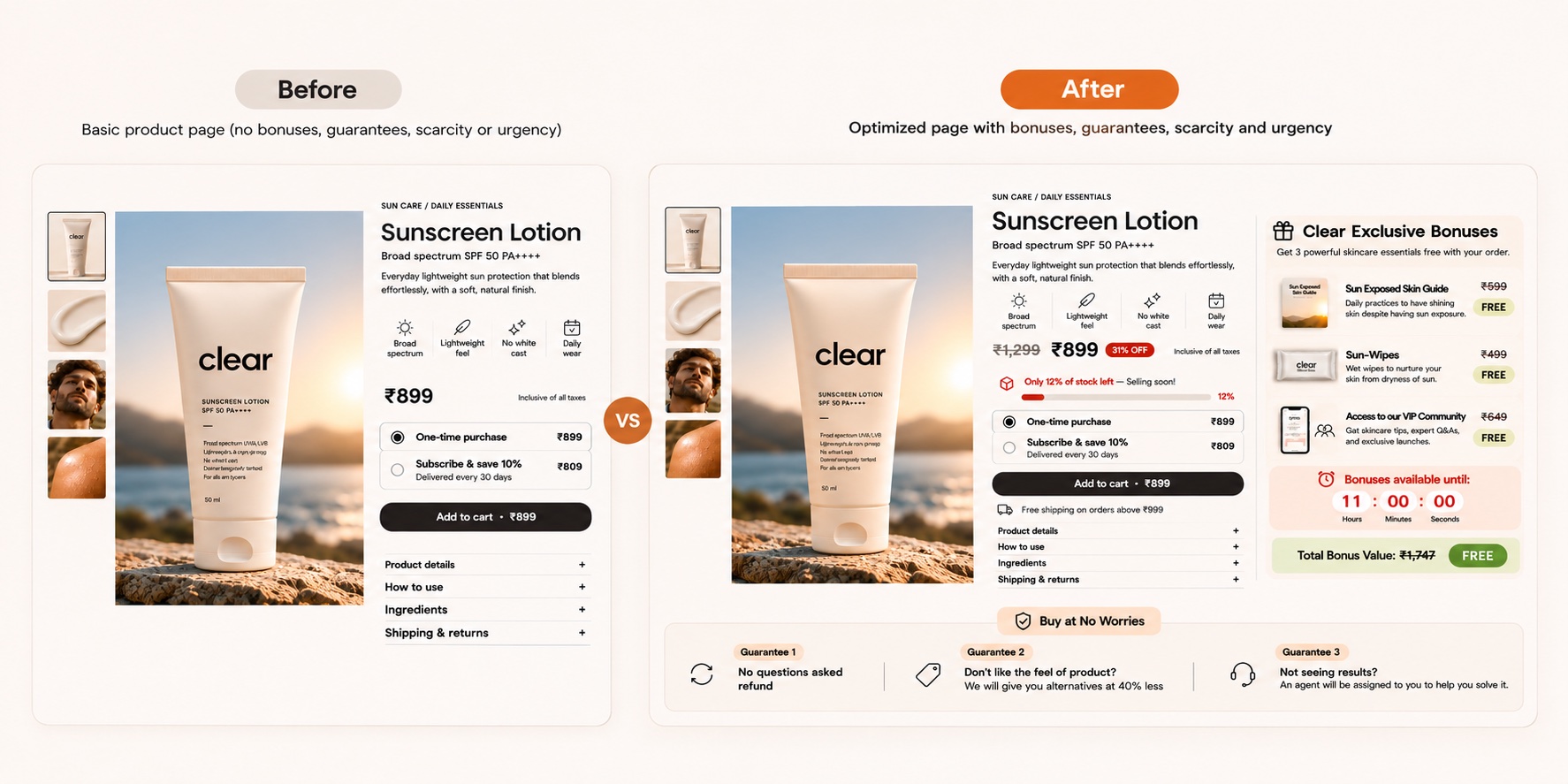
You can see a clear distinction here and each part of it is intentional.
As a simple 2x in conversion rates are a 2x in your D2C sales without any ad spend, we could go above and beyond with this…
Now that we have covered the major bonuses, let's look at the minor ones that cause small bumps in conversion % but are crucial to MAXIMISE for conversion and not just OPTIMISE..
Naming the bonuses strategically is important as it shows the potential buyer it is here for a reason. Especially if your bonuses are actually useful.

Here we have "Clear Exclusive Bonuses", "Summer Special Bonuses", "Founder Gift".
This helps establish context and gives the buyer a reason why these bonuses are included.
There are many more such tiny details that can play a role in incremental improvements of 0.2–0.3% in conversion rates.
This concludes the offers section, which can account for a significant portion of the initial buying decision, as most people who land on the page are going to see this in the first glance & we want to be optimised for that first glance.
The offer is the tip of the iceberg and is what makes the overall page more compelling.
No matter the influencer, celebrity, product or compelling price…
A weak offer will rarely perform as well as a strong, compelling one.
How this could go HORRIBLY WRONG are a couple of ways:
- Being overly aggressive with your offer can make buyers suspicious that something is wrong & create signals of misleading or deceptive commercial practices.
- An offer being mismatched with the product will REPEL potential buyers, potentially costing you conversions.
- Testing too many variables and bombarding the page will make it difficult to strategically test these elements and understand what your specific ICP responds to.
- Bombarding and cluttering the page with too many elements can confuse the potential buyer, potentially worsening the result.
- Irrelevant bonuses and overly aggressive scarcity and urgency can make buyers lose trust because it starts looking like your brand is trying too hard to sell.
You need a system that makes sure you are evaluating the results without betting the house on it.
Sequential split tests that help you understand what your Ideal Customer Profile might respond to within your specific product category.
Now, if you want all of these benefits while managing the risks that come alongside them,
& you want experts who have experience implementing and testing these strategies regularly, hit the link down below.
Step 2 of Lever I (High CR%): Making the Landing Page Compelling
The offer is what we sell on the landing page & not just the product.
Yes, the product is at the forefront, but the offer is the weapon behind it.
A weak offer but a compelling landing page will give you average-to-good results.
But a SUPER COMPELLING OFFER + an average landing page that effectively sells the offer can give you great results.
So the landing page is designed methodically to sell the offer and communicate the potential benefits of the product.
Starting with THE MOST important part of the landing page.
LANDING PAGE BOOSTER #1: A COMPELLING TITLE
The title is a significant part of your first impression because their eyes are naturally drawn to the title before anything else.
Bore them with your title? They might not give your offer a chance.
It can be funny, it can be entertaining, it can be educational, it can be playful, but it CANNOT BE BORING.
The title should ideally do two things at once: grab their attention and communicate the value of the product.
The title is where the magic happens in terms of communicating the product's value subtly.
The prospect understanding the value of your product has a few steps to it. They need to understand a few things before they purchase to recognise the potential value of what you're offering.
Let's break down these 4 things:
- They need to understand the desired results they could achieve with the product in the forefront.
- They need to believe that your product is designed to help deliver those results.
- They need to feel the wait for those results is short.
- They need to feel it takes little effort on their end.
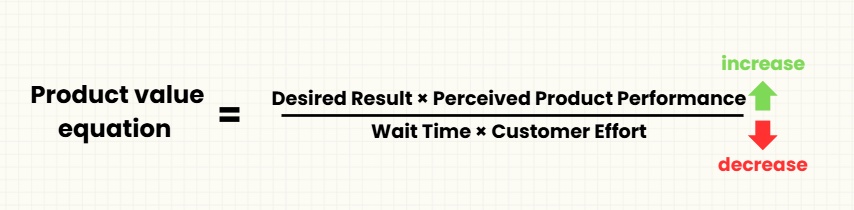
Product Value Equation = Desired Results × Perceived Product Performance / Wait Time × Customer Effort
The result can be framed in terms of moving away from pain, towards pleasure or a combination of both…
It can be how our sunscreen helps protect your skin from UV exposure (away from pain) or supports your everyday skincare routine (towards pleasure).
The perceived product performance can come from how many people have used it, who has endorsed it (celebrity/influencer endorsements) or the product features and benefits that help communicate its value.
Wait time can be about how quickly the product arrives and how soon customers can start using it, or it can even be about the time required to experience the potential benefits after using it.
For example, a creatine supplement can communicate wait time in terms of delivery speed and how quickly customers can start incorporating it into their routine, or through realistic, substantiated information about the timeframe associated with its intended use.
Effort can be the same in terms of how easy it is to purchase the product (only 3 clicks to buy) or how easy it is to incorporate the product into an everyday routine (only one scoop a day).
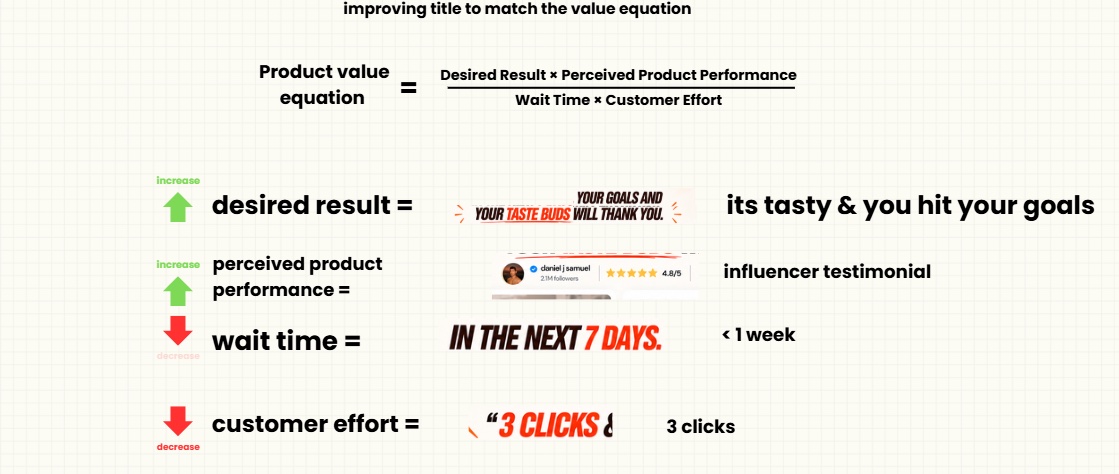
We put this into action for a client of ours, and each iteration followed the Product Value Equation more closely, with the objective of increasing perceived value.
And you can see how the different iterations influenced conversions.

Each part of the value equation should be tied down to the desires of the ICP and how it can be a major factor in increasing the perception of your product.
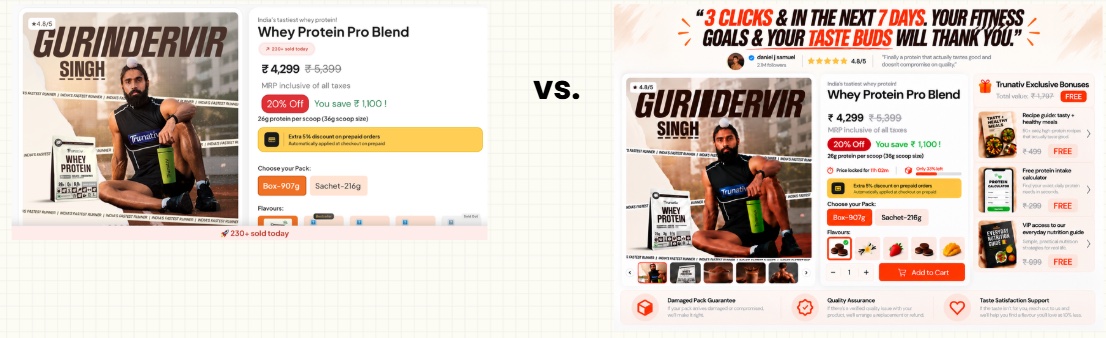
In this specific instance lets see how it looks before and after the page for the protein brand.
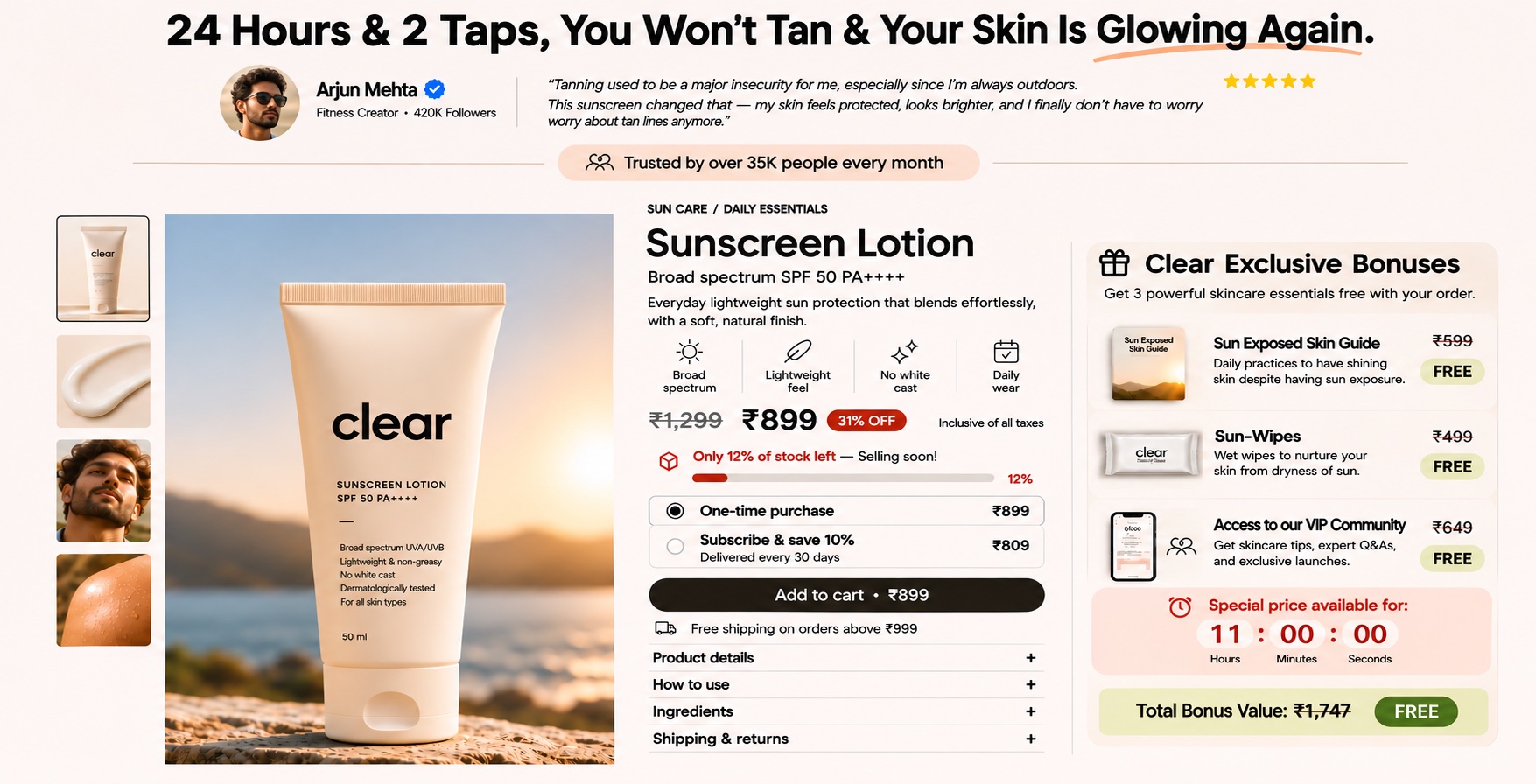
Now let’s take this for the hypothetical skin-care brand clear that we made and how we can use the product value equation in order to enhance the offer even more.
Here is the Title based on our product value equation that we have used.

This follows almost every part of the value equation to a T,
“24 hours” reducing the time delay
“2 taps” reducing the effort on their end
“You won’t tan & your skin is glowing again” selling on dream outcome
This followed with an influencer testimonial from an influencer that represents our ICP speaking about the situation that the ICP is mostly in… Right below it is “Trusted by over 35k people every month”
And when we put it together in the page with our GODFATHER OFFER this is how it looks
Now if we take this and put it without the title you can see how it looks a bit bland before and didn’t have that “it” factor
Ideally we need to at least try to nail 2 parts of the equation really well in most cases… Hitting 4 would give us the best results.
We can always declutter this and make it minimal as long as the principles behind it are being followed.
This doesn't have to come at the sacrifice of your brand tone, palette or themes…
But the fundamentals behind the offer design must be addressed.
Out of all the tests on the page, A/B testing titles regularly is an important one and should ideally be tested every 2–4 weeks, depending on traffic volume and statistical significance.
As a general testing framework, every 100k visitors can provide an opportunity to evaluate a title variation. This could be every month, every week or even every day, depending on your traffic volume.
LANDING PAGE BOOSTER #2: Longer landing pages (selling the offer) vs. shorter landing pages (selling the product)
"Buy my pen"
"Buy this pen and you get a notebook free, an ebook on how to style the pen with your formals.
If for any reason you don't like it, we'll help you explore the available options under our return policy. The offer lasts 10 days."
Do you see what is more compelling?
Selling the product vs. selling the offer.
We want to always sell the offer and not just the product.
We want to do this in every way possible:
- Video testimonials from influencers.
- Long-form copy.
- Written testimonials from peers within the ICP.
- Features & benefits section of the page.
- Us vs. them section of the page.
We want every part of the page to communicate and reinforce the offer.
And based on the split tests we have conducted, longer landing pages have often performed better when they effectively address objections and communicate the offer.
Don't believe me? Just go see Apple's product pages for the past five iPhones launched.
Their product pages progressively communicate more information, features, benefits and reasons to consider the product rather than simply presenting the device.
These principles are widely used by some of the biggest brands in the world, yet somehow they remain hidden in plain sight.
Longer copy breaking down potential objections to the offer and communicating offers using basic features, benefits and what they mean for the customer can be a valuable approach.
LANDING PAGE BOOSTER #3: Using Influencer Testimonials Strategically
Unlike the rest of this page, this is more of a tactical approach than a timeless principle… (shamefully so, but it works).
After the influencer testimonial basics are sorted, like influencers matching our ICP and making sure that the product demonstrations in their testimonials are consistent with the experience presented on your page…
An easy lever to pull is to divide your influencer testimonials into two parts:
- Handling objections in a subtle and smooth way.
- Selling the offer rather than just the product without sounding salesy.
Being intentional with influencer testimonials is important because, when you're positioned correctly, your ICP will be looking at familiar creators to understand why this offer could be the right decision.
Once you get the offers right, working on influencer testimonials is definitely worth considering.
You can pitch this to your influencers by showing them how your brand's positioning can be enhanced by the words they use & it may even be worth compensating these influencers for additional content rights and deliverables, as well-crafted testimonials can become valuable assets for your marketing campaigns.
The landing page is a long topic and since this is merely just the biggest takeaways, there is a lot more to cover. This would be a 20-hour read if we put all of the principles we use into it, so we had to condense it down to the important bits…
However, my team can work on your offer and landing page fully so that you can evaluate these improvements before you even sign an agency, pour more into ads or rework your team with star-level talent…
We can show you the details and work through your offer and landing page on our free Constraint-Clarity Call.
Hit the link down below.
Step 3 of Lever I (high CR%): Fixing all potential buyer logistic frictions
The goal here is to identify and eliminate as many obstacles as possible between a customer wanting a product and successfully receiving it.
The key idea: buyer friction isn't just a checkout problem. It's every moment a customer hesitates, encounters a restriction, loses confidence or has to wait longer than expected to get what they want.
Instead of boring theory, let's SPICE THIS UP and have quick takeaways across multiple points.
FRICTION REDUCTION SYSTEM 1: Payment flexibility: remove the inability to pay
Objective: Make it easier for customers with different payment preferences, banking situations and spending habits to complete a purchase.
1. Accept all major credit and debit cards
Support relevant card networks, domestic cards and international cards where applicable. Check card declines by issuer, network, device and payment gateway.
Measure: Card authorization rate, payment failure rate.
2. Offer cash on delivery (COD)
Essential to test in markets where customers prefer paying on receipt or have concerns about prepaid orders. Use COD eligibility rules, address verification and risk-based restrictions to control return-to-origin costs.
Measure: COD conversion rate, COD cancellation rate, RTO rate.
3. Introduce buy now, pay later (BNPL)
Give eligible customers access to supported installment or deferred-payment providers. Display the payment schedule and any applicable fees clearly before purchase.
Measure: BNPL adoption, conversion rate, average order value (AOV), contribution margin.
4. Support UPI and instant bank payments
For Indian stores, offer familiar UPI flows, intent-based app handoffs and other relevant local payment methods. Minimize the need to manually copy payment details.
Measure: Payment completion rate by method, failed handoffs.
5. Enable secure saved payment methods
Let returning customers reuse eligible payment credentials through tokenization and authorized wallet features instead of re-entering everything.
Measure: Returning-customer checkout completion, time to purchase.
6. Add express checkout and digital wallets
Support relevant options such as Google Pay, Apple Pay and other locally popular wallets. Prepopulate available shipping and billing information with customer consent.
Measure: Checkout steps, completion rate by wallet, mobile conversion.
More payment-friction fixes
7. Display payment methods early: Show accepted methods on product pages, not just at the final checkout step.
8. Show EMI options on product pages: Where available, display the actual eligible monthly installment and applicable terms before the customer adds to cart.
9. Provide bank-specific offers: Surface eligible card discounts or instant bank offers before checkout, rather than surprising customers with restrictions later.
10. Recover failed payments: Provide a clear retry button, alternative payment methods and a safe way to resume an interrupted checkout.
11. Reduce unnecessary payment redirects: Keep the payment journey consistent and make external gateway handoffs understandable.
12. Handle delayed payment confirmations: Clearly communicate pending payments, prevent duplicate charges and automatically reconcile order status where possible.
13. Make COD availability transparent: Check the PIN code or postcode early and explain when COD is unavailable.
14. Support gift cards, store credit and vouchers: Allow eligible balances to be applied without making customers restart checkout.
15. Allow split payments where supported: Enable eligible combinations of gift cards, store credit and another payment method.
FRICTION REDUCTION SYSTEM 2: Shipping speed: reduce the waiting-time objection
Objective: Give customers the fastest feasible delivery option and make the delivery promise specific to their location.
16. Offer standard and express shipping
Let customers choose between a lower-cost standard option and a faster paid or subsidized option. Show the estimated delivery date for each.
Measure: Express uptake, shipping contribution, checkout conversion.
17. Introduce hyper-express shipping in high-demand zones
Map orders, customer density, warehouse proximity and courier capacity. Offer same-day, two-hour or other ultra-fast delivery windows only in PIN codes where the operation can reliably meet the promise.
Measure: On-time delivery, cost per expedited order, incremental conversion.
18. Display an estimated delivery date on the product page
Use the customer's PIN code or postcode to show a realistic arrival window before they reach checkout.
Measure: Product-page-to-cart rate, delivery-related exits.
FRICTION REDUCTION SYSTEM 3: Additional shipping and delivery optimizations
19. PIN-code serviceability checker: Let shoppers confirm whether their location is serviceable without starting checkout.
20. Dynamic delivery promises: Calculate ETA using warehouse location, inventory, courier cutoff times, holidays and destination.
21. Same-day dispatch cutoff: State a genuine cutoff, such as orders before 1 p.m. dispatching the same day, where operationally achievable.
LEVER II: Maximising Average Order Value (Getting each buyer to buy for more)
Step 1 of Lever II (high AOV $): One-time-Offers (Upsell/Crossell)
One-Time Offers are offers that appear right before customers complete their checkout. These could be upsells or cross-sells…
From our data, we find upsells to be a strong starting point and often the safer bet, as customers may be more likely to purchase additional quantities of a product they have already chosen rather than an entirely new complementary product (unless you have data supporting that cross-sell).
For our skincare brand, we can introduce a basic monthly stack-up so that customers don't have to come back and purchase the product every week (assuming each unit lasts approximately one week).
We want to introduce a straightforward upsell like this that gives customers a convenient way to stock up while creating an opportunity to increase the average order value towards 3x the original purchase value.
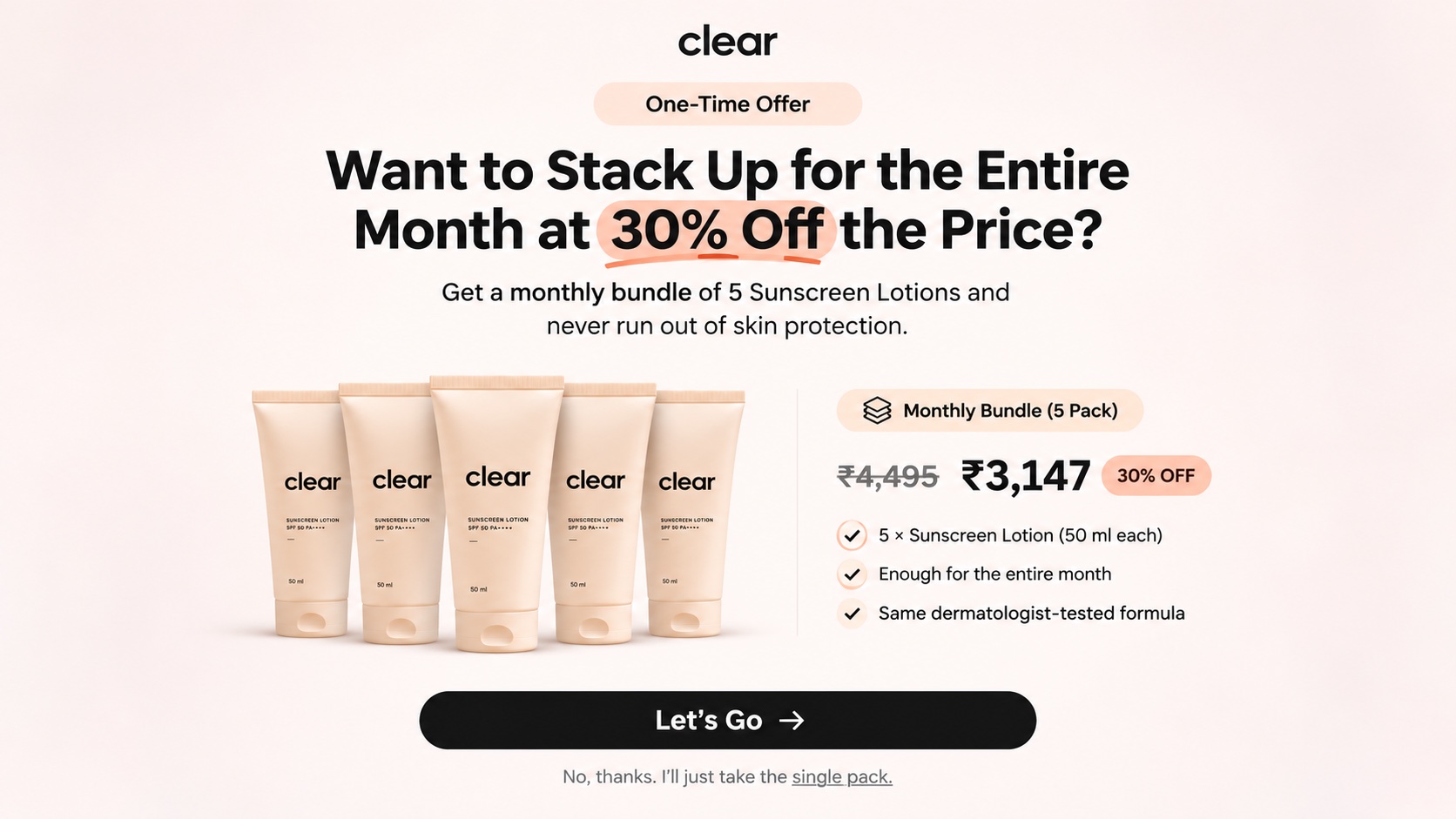
If we were to test this with a cross-sell instead of the up-sells, hypothetically a natural next would be a body-lotion alongside a sunscreen.
We could also test with these following products:
- Wet wipes to wipe off the sunscreen
- Facewash + wet-wipes to wipe off the sunscreen
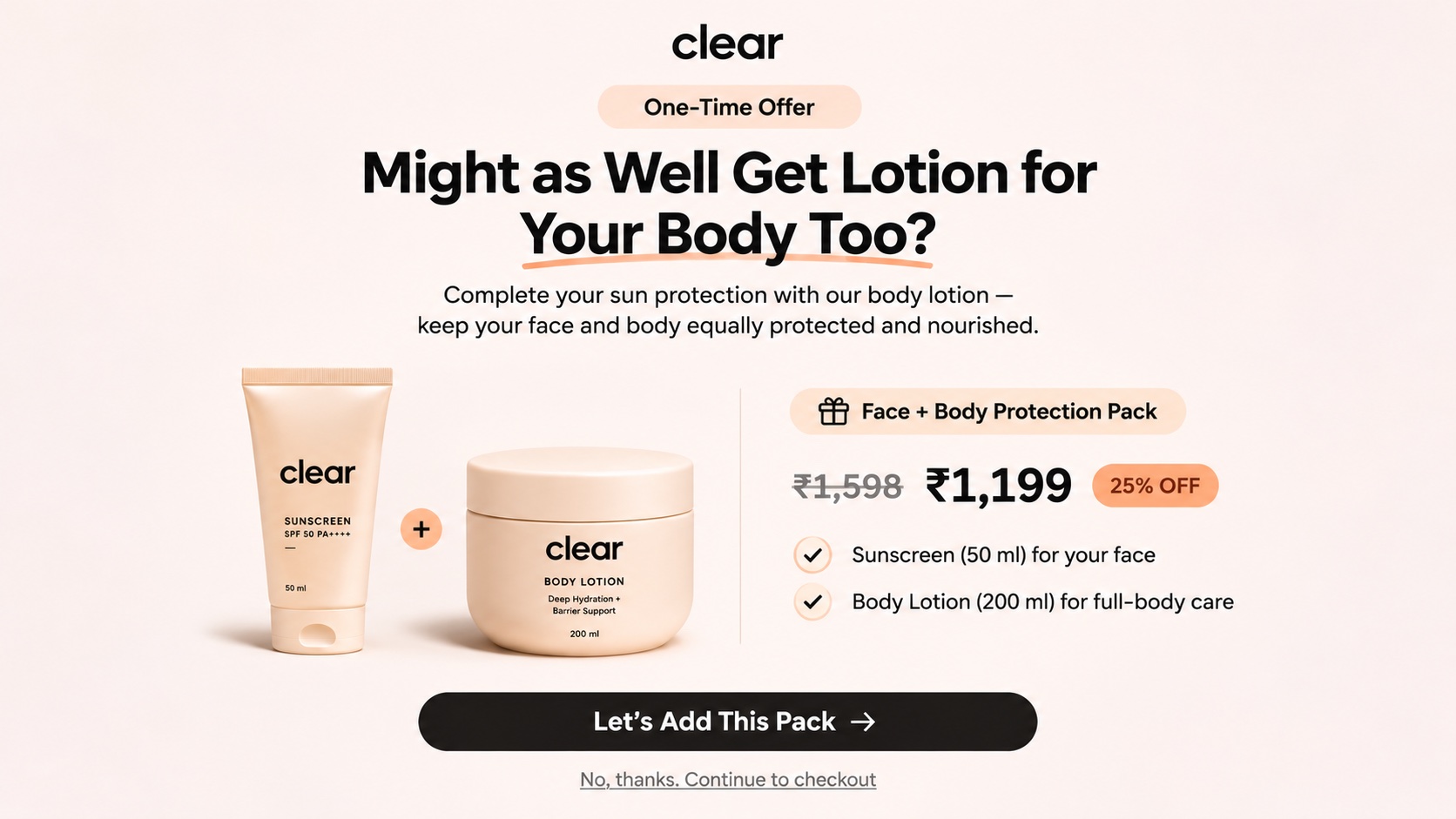
Although this might be a slightly riskier play than the upsell, it could be more fruitful if implemented correctly.
It is worth noting that we would ideally optimise conversion rates before working extensively on average order value and One-Time Offers.
This is because introducing additional offers might create some friction and potentially impact conversion rates. However, the increase in average order value could compensate for that, provided the additional revenue and contribution margin outweigh the impact on conversions.
There is also potentially less operational complexity to deal with in terms of shipping logistics, alongside an opportunity to improve margins, because your existing CPMs aren't necessarily bringing in MORE LEADS, but instead helping you generate more value from each customer you acquire.
Step 2 of Lever II (high AOV $): Downsell One-time-Offers
Once all of the OTO tests are being conducted and that initial traction is coming through, we can start looking at the data to identify emerging patterns.
If the OTO purchase rates are consistently over 45%, that's an encouraging signal that the offer and ICP might be well aligned.
However, if we want to turn it up a notch and explore additional opportunities to increase AOV, we can introduce an OTO downsell…
So instead of offering a 1-month refill, we can introduce a smaller 1-week refill at a lower price point.
This gives customers another purchasing option while allowing us to capture additional orders from people who may not be ready to commit to the larger bundle.
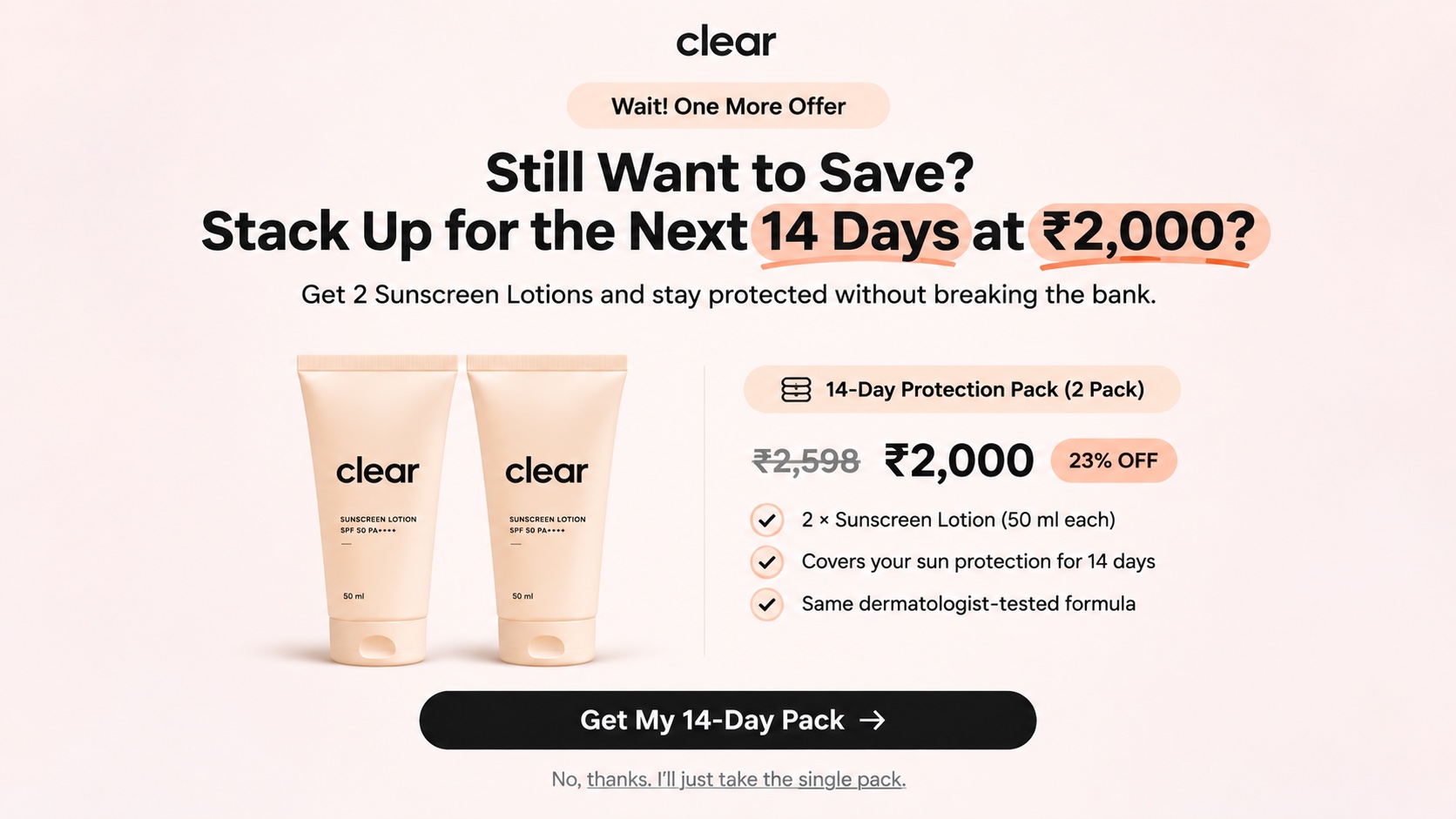
Now it is important that the data before the OTO is being tracked. So if the orders on the OTO hit that 40-45% mark it is safe to test that downsell on the remaining 60% we do not want to bombard the potential buyers to risk the whole house.
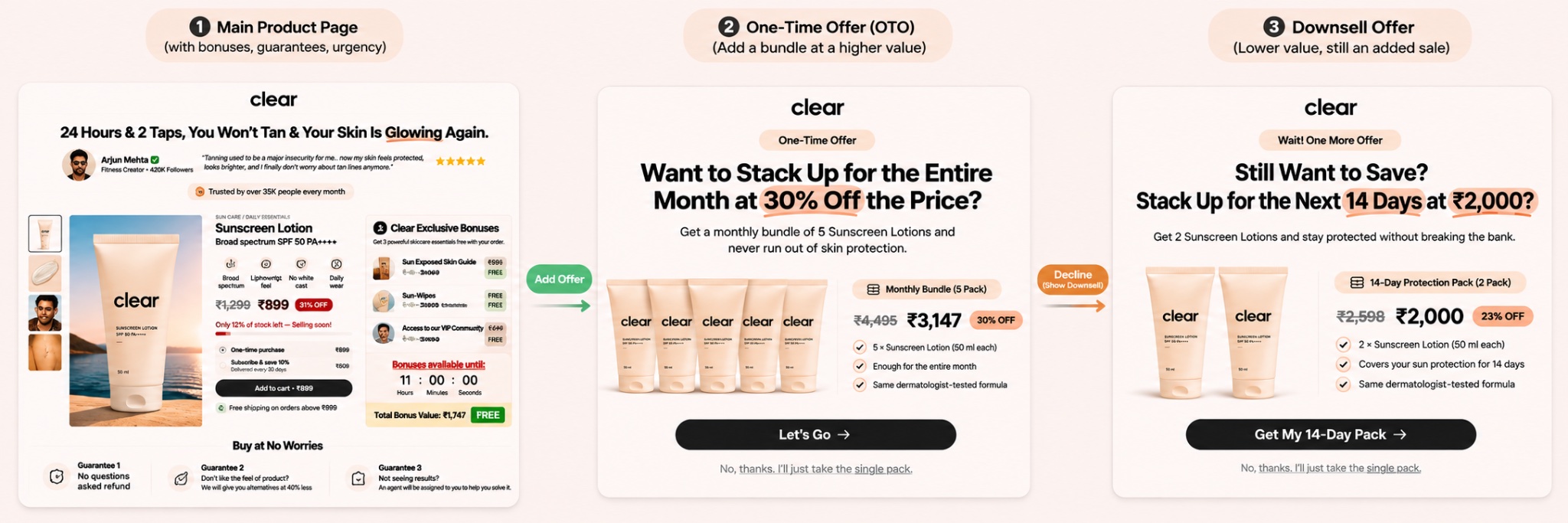
This is the flow of the sequence:
- Main offer page.
- One-Time Offer (Upsell/Cross-sell).
- Downsell the OTO.
Now, this is limited by your creativity and can be implemented in many different ways.
But not betting the house on this is crucial, as your hard-earned traffic shouldn't be wasted on tests that haven't been strategically thought through.
In this case, the main offer was $14, followed by a One-Time Offer for a sunscreen upsell: a 30-day pack for $31, with a downsell offering a 14-day pack for approximately $20.
Every test conducted should have data behind it, and we recommend approaching this in a risk-conscious way, where you test one element at a time with a controlled segment of your traffic.
I recommend the downsell being a meaningful price reduction, typically around 20–40% lower than the price of the original upsell or cross-sell, depending on the product economics.
Make sure that the product in the downsell is the same as the upsell or cross-sell, ideally with a smaller quantity or package size, rather than introducing a completely different product, as we don't want customers to be overwhelmed with choices.
The downsell is worth considering once we establish a healthy OTO purchase rate, with 30–40% serving as an initial test threshold.
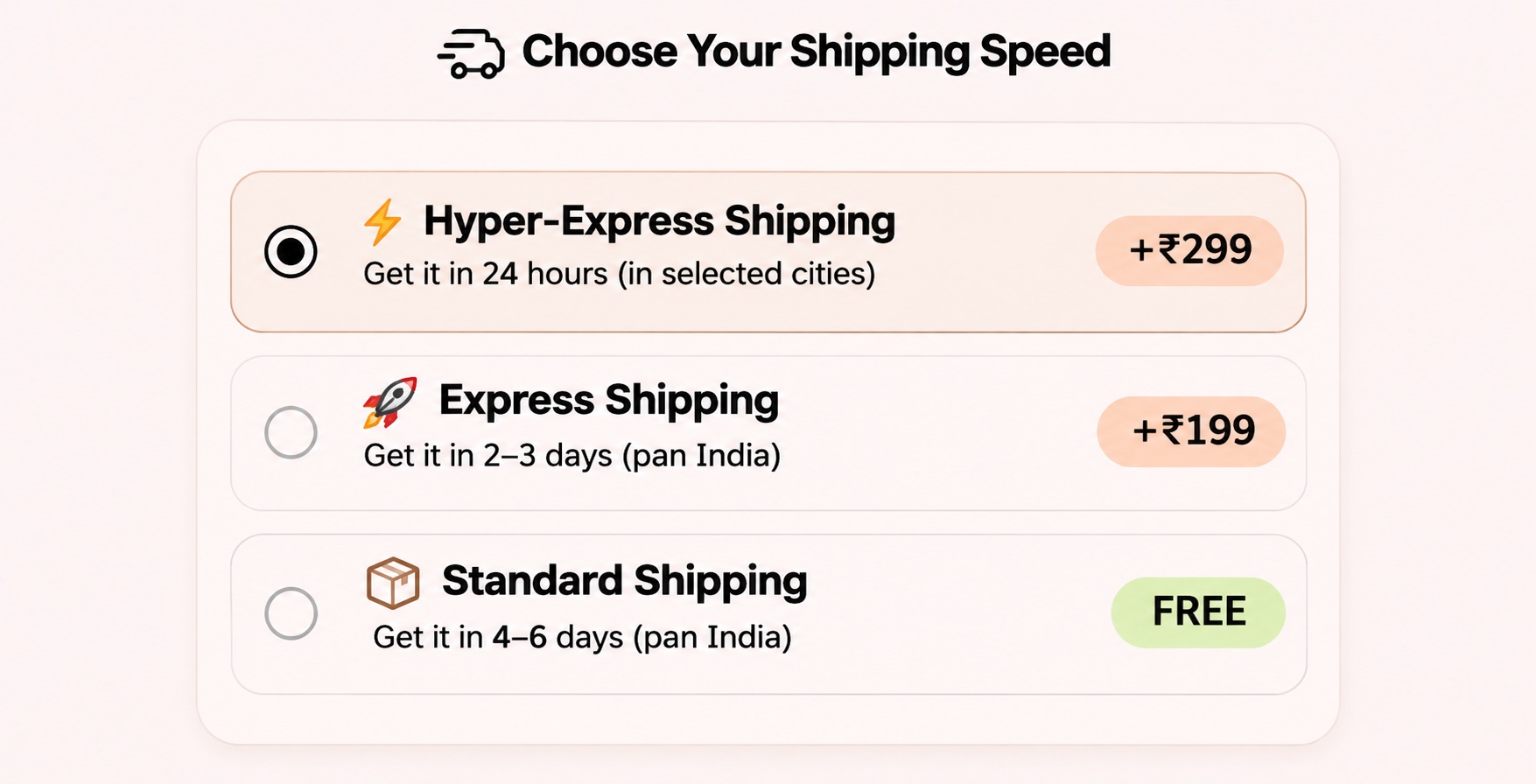
Step 3 of Lever II (high AOV $): Hyper-express shipping & express-shipping
Now, a segment of your buyers might be willing to pay an additional 10% for faster delivery and potentially 20% for hyper-fast delivery.
This is why having express shipping & hyper-express shipping options comes in.
Strategically pricing these options can play a great role in increasing your average order value and creating additional margins to work with.
You could always make sure that you have logistics partners offering express shipping & hyper-express shipping, especially in high-demand zones identified through your order and delivery data.
The key is to identify where customers are willing to pay for speed and build your delivery options around those locations.
Step 4 of Lever II (high AOV $): Extended Warranty Option
Buyer-friction category: perceived risk, repair costs, replacement uncertainty and post-purchase anxiety.
An extended warranty is an optional product-protection plan that covers specified failures or repair costs beyond the scope or duration of the included manufacturer's warranty, subject to its terms.
For e-commerce brands, this can create an additional revenue stream without requiring the customer to purchase another physical product.
The commercial opportunity is to offer genuinely additional protection at a transparent price, with clearly defined coverage and a reliable claims process.
Now, obviously, this doesn't apply to all categories, but you can explore this strategically depending on the product you're selling…
We can leverage consumer-protection awareness and offer customers an additional extended warranty option that provides protection beyond the standard product coverage.
We were once working with a company that sells cookie ovens. The D2C funnel showed improved conversion performance and higher order values after an optional extended warranty offer was introduced.
FINAL LEVER & NOW YOUR TURN: Putting everything into action
Now that you have made it here, you know exactly what to evaluate and what levers to pull.
Logically, improving your website's conversion rates and increasing the value of each order can be one of the most accessible opportunities compared to many other growth initiatives.
How do you start and put everything into action right now?
The steps are simple but uncomfortable.
Because we don't want to bet the farm on something we have never tested,
Especially in the core part of the business.
Playing it safe is super important as you figure out the winning offer, landing page, product upsell sequences, etc.
This is why we came up with a plan to implement this systematically,
Evaluating every important element of the page to help you work towards better AOV & CR%.
There are a few principles behind why we made this plan,
Then we'll get into the tactical stuff…
Firstly, we do not want to bet the whole farm and change too many variables at once, because you will never know what your audience is responding to. Tracking performance and identifying constraints can become a headache later on.
Secondly, we cannot work on a large test group from the get-go. We need to start with a smaller, controlled test group, evaluate the results and gradually scale the changes that demonstrate positive performance, rather than exposing the entire flow of traffic to an unvalidated test.
Yes, the strategies on this page are based on established e-commerce optimisation principles, but if you are spending millions a month on ads, we want to make sure we respect the value of that traffic and approach every implementation with a risk-conscious methodology.
Now let's get into the tactics for implementing all of this in a risk-conscious way.
Step 1: Pick one metric to work on at a time, with one goal and one product.
Do not work on everything together unless you know what you are doing.
Pick one metric like: conversion rate or average order value.
Let's say conversion rates and work on just that without changing the average order value…
Although it can be preferable to work on average order value first and then move into conversions, as AOV is often influenced by our back-end systems & conversion rates can become the force multiplier on top of this.
And on top of this, just work on one product at a time and not every SKU together.
Do not overwhelm your team and make your tracking messy by working on every product at the same time, especially when this is your first time working on your core WRM metrics.
For the sake of this example, let's take the scenario where we are working on Clear's sunscreen average order value, with a target of moving from $8 to $30 using a sequence of upsells.
We have a clear product we are working on: sunscreen.
We are working on one metric: Average Order Value.
We are working on one goal: to move from $8 to $30.
Step 2: Work on one variable at a time, with one goal for each variable to help achieve the larger objective.
Once we pick the goal, product and metric, the next step is to work on a few sub-goals to meet the overall objective…
Meaning each metric we work on has a goal attached to it.
You can get creative with this in a multitude of ways, but the testing has to happen with one variable at a time…
Let's go back to our implementation example of improving the AOV of Clear's sunscreen from $8 to $30 using a sequence of upsells.
With product: sunscreen.
Working on one metric: Average Order Value.
Working on one goal: to move from $8 to $30.
Now let's put this into action.
First, we might A/B test a basic upsell of a monthly pack versus a cross-sell.
AND THAT IS THE ONLY THING WE WORK ON.
So we are looking for this test to help us move average order value towards $16 or more.
Do not change anything else until we have identified a stronger-performing upsell through our A/B test of cross-sell versus upsell.
We first identify the winning upsell and evaluate whether it helps us reach the $16 target…
Now, after 4–6 weeks, if the data supports that improvement,
We want to move this $16 towards approximately $21–24…
So we introduce a downsell to visitors who didn't accept the original upsell.
So we identify the better-performing downsell and evaluate whether it helps us reach the $21–24 target first…
After a few more weeks of running and evaluating the tests,
Now we want to work towards our final goal of $30, so we test express shipping versus hyper-express shipping on top of the two changes we have already made…
So, in this hypothetical example:
The upsell took our AOV from $8 to $16.
The downsell took it from $16 to $24.
The shipping options took AOV from $24 to $30.
There we have it. This is the potential winning playbook for improving AOV…
Now we take the patterns out of this and replicate them across products.
Step 3: Smallest effective test group & scale gradually.
Especially if this is your first time working on your WRM metrics & this is your team's first time working with the system, you want to be safe.
Think of it like going to your first boxing class, but having work to show up to the next day. You would wear the safety gear, not go too hard and play it safe so that you are good in the long run…
There are people who go hard as hell on their first day without knowing the fundamentals, so they get injured and never really get to work on their skill.
This is where we want to be methodical so that in the long run we catch a rhythm.
Start with a controlled group of visitors, with the sample size determined by your existing traffic, conversion rate and the improvement you want to detect.
Pick the metric, pick the product, pick the goal, pick the sequence of tests and start with an appropriate visitor sample.
Track the results.
Then gradually extend the test to larger segments as the data supports it.
For example:
Start with 30K visitors.
Then extend to 90K visitors.
Then extend to 200K…
And so on.
These are illustrative testing stages, not fixed requirements for every brand.
Step 4: Scale WRM across metrics & products.
Going back to the example of taking AOV of Clear's sunscreen from $8 to $30,
Once we have established a stronger AOV, we want to evaluate opportunities to improve CR%, for example, from 1% towards a 5–6% target.
So we follow the same sequence of steps (Step 1–3) for improving conversion rates,
Where we pick one goal, the same product and CR as the one metric to improve.
Then the sub-goals & mini-tasks: let's take an example…
We want to move this conversion rate from 1% towards 2.5% using compelling bonuses,
So we introduce them and test different variations until we identify what performs better.
Now we want to work towards 3%, so we test genuine urgency & scarcity…
Pushing towards a 4.5% conversion rate, we introduce three specific guarantees designed to address purchase concerns:
- One that addresses the perceived risk of making the purchase.
- One that addresses concerns around product quality and potential defects.
- One that provides additional protection and support over the longer term.
So far, the offer enhancements have helped us work towards improving the conversion rate from a 1% baseline to a 4.5% target in this hypothetical scenario.
Let's look at how we can take this from a 4.5% conversion rate towards a 6% target.
We do it through working on landing-page design:
- We introduce a product-value-equation-based title (& A/B test it).
- We add copy selling the offer.
- We introduce influencer testimonials that address potential objections.
Now, although we have done all this, we find that our conversion rate is at 5.5% and isn't reaching the 6% target yet.
Looking at the tracking data, we see that checkout is where a significant number of visitors are dropping off.
Now we work on making the experience easier through multiple shipping options, simpler checkout flows and more payment options.
And reduce as much buyer friction as possible.
Boom… in this hypothetical example, the conversion rate reaches 6.5%.
This is how we could approach improving conversion rates from a 1% baseline towards 6.5% and average order value from $8 towards $30 and beyond.
Now, taking this further, we might have observed patterns in offers, landing-page designs & product upsells, etc…
We replicate these learnings across products and not just sunscreen.
We use the emerging patterns across the wet-wipes product line, the face-mask range and other products…
This is the process of systematically improving your overall website conversion rates & order value while managing implementation risk.
A WORD OF WARNING (read before you implement)
If you do everything on this page SKILLFULLY, you can create meaningful improvements in conversion rates and average order values without necessarily adding headcount, increasing ad spend or relying on more influencers.
And the even greater upside?
Every additional dollar you invest in advertising afterwards whether through ads, affiliates or organic content has the potential to generate more revenue because your offers, product pages and upsells are better positioned to convert that traffic.
But...
There is a darker side to this.
Making these changes without properly tracking data or having the right experience can go seriously wrong.
A simple example: too many bonuses can overwhelm customers, while irrelevant bonuses can make your offer feel overly sales-driven.
This may reduce conversion rates rather than improve them.
The wrong types of upsells can also reduce AOV and conversion rates because customers feel bombarded with one mini-pitch after another.
Making too many aggressive changes at once, without a streamlined process to manage risk and measure results, may produce a change in performance but you'll have no clear idea which specific change is working and which one is failing.
Or worse, several variables could collectively bring down your conversion rate and AOV because one poorly executed change is undermining the entire experience.
Without a proper testing process, identifying that problem becomes significantly harder.
Disingenuous scarcity and urgency can also damage your brand's reputation. Imagine a returning visitor landing on your page and seeing the exact same countdown timer running again. They may recognise the tactic, lose trust in the offer and develop a negative perception of your brand.
When it comes to optimisations that directly affect your business, every touchpoint matters. Every variable needs to be thought through, tested and supported by data.
One poorly executed change can have a disproportionate impact.
However, when you work with a growth arm, you have an experienced team helping you manage that process.
Why?
Firstly, a growth arm like ours brings experience from working on WRM across multiple clients and product categories. That experience can help your brand avoid common mistakes and implement relevant improvements more efficiently.
Secondly, patterns and learnings from different product categories can help inform your next experiments so you're not starting from scratch every time.
Thirdly, the tools, tracking and testing processes are already established, allowing us to deploy and evaluate experiments in a more organised way.
Fourthly, you save your team's time and energy, allowing them to focus on the areas of the business that require their direct attention.
If nobody on your team has experience working on at least 12 AOV and conversion-rate optimisation engagements with tangible improvements in the metrics across different products and e-commerce brands I would recommend thinking carefully before betting the farm on an experiment.
Hit the button below to find out how we could potentially help your brand starting with a free initial assessment & a build plan.
Disclaimer: Brand names in this article, including “Clear”, have been changed to protect client privacy, and the product pages, testimonials and images shown are illustrative. All figures, projections and conversion rate, AOV and ROAS examples are hypothetical or illustrative. They are not guarantees or typical results. Actual results depend on your product, market, traffic quality, margins and execution, and will vary from brand to brand. Use scarcity, urgency, guarantees and warranties only where they are genuine and comply with the consumer-protection laws and advertising rules in your market. This article is general information, not legal, financial or compliance advice.